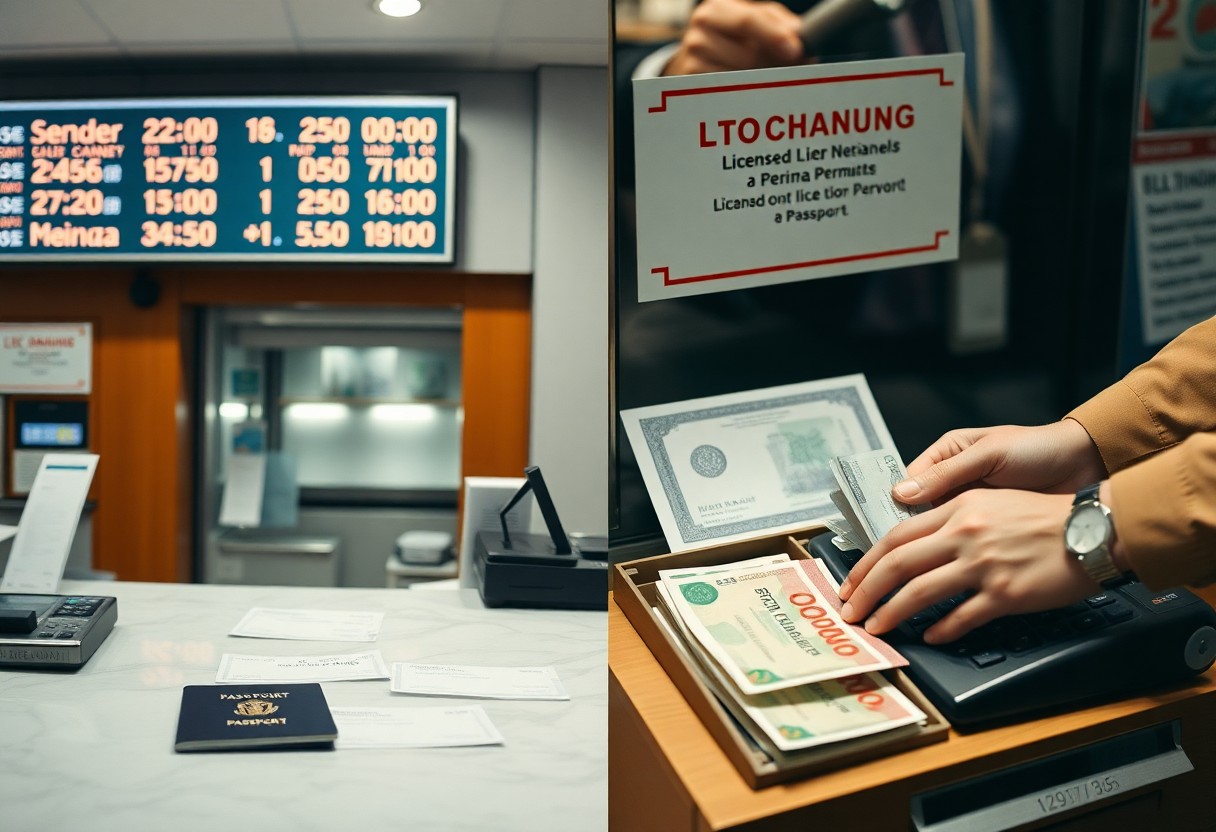
Over time you’ll see small spreads and fees compound, so you should compare bank exchange rates and authorized money changers side-by-side-check spreads, commissions, and the mid-market rate to choose the most transparent, cost-effective option for your transactions.
Key Takeaways:
- Banks often quote less favorable rates and may add fees, but provide strong security and clear documentation.
- Authorized money changers frequently offer better mid-market rates and lower commissions, though quality and trustworthiness vary.
- Compare the effective cost by calculating the net rate after fees and commissions, not just the advertised rate.
- Consider currency availability, transaction limits, and speed-some providers handle exotic currencies or large cash needs better.
- Use licensed, well-reviewed providers, verify identification and receipts, and avoid unregulated or cash-only operators.
Understanding Bank Exchange Rates
When you use a bank for foreign exchange, the rate you get is typically the interbank mid-rate plus a markup and sometimes a flat fee; retail markups commonly range from about 0.3% to 3.0% depending on channel, size, and client status. You benefit from compliance controls, documentation, and settlement guarantees, but those protections often come with wider spreads than wholesale or specialist providers.
Definition and How They Work
Banks quote customer-facing buy/sell rates by adding a margin to the interbank price and adjusting for expected hedging cost and operational expenses; branch counters may add a larger premium than online platforms. You submit the amount, bank confirms a quoted rate, and settlement follows standard banking rails with KYC and transaction records retained for audit.
Factors Influencing Bank Rates
Multiple variables determine the final quote: central bank policy, interbank liquidity, transaction size, client relationship, hedging costs and operational overhead. For example, after a 25 basis-point central-bank move banks often widen retail spreads; meanwhile, corporate clients or transactions above $50,000 typically see tighter margins.
- Monetary policy – rate hikes or cuts shift the interbank benchmark and can tighten or widen spreads.
- Liquidity – lower market depth (e.g., thin hours or holidays) leads banks to add larger buffers.
- Transaction size & client tier – larger deals or preferred customers frequently earn discounts.
Perceiving how each factor behaves in real markets helps you time conversions and choose providers who align with your priorities.
Banks also price in compliance and settlement risk: KYC/AML checks, SWIFT fees, and hedging durations affect small retail transfers more than large corporate ones. In practice, you might see a 0.5-1.5% markup on a $1,000 retail exchange versus 0.1-0.4% on a $100,000 corporate FX deal, and volatile events (e.g., major elections) can push margins much higher.
- Operational & compliance costs – KYC and sanctions screening add time and spread to pricing.
- Hedging approach – banks pass forward-hedging and inventory costs into quotes.
- Market stress examples – events like Brexit 2016 or sudden rate shocks have historically driven banks to widen retail spreads substantially.
Perceiving these mechanics lets you negotiate better terms, time conversions when spreads tighten, or opt for a specialist when bank margins become prohibitive.
Authorized Money Changers Explained
Definition and Operation
Authorized money changers are licensed by central banks or financial regulators and operate retail counters, kiosks and online desks where you can exchange cash without a bank account. You’ll encounter spot trades, bulk OTC transactions and occasional forward contracts; identification/KYC is typically required above local thresholds (often $1,000-$2,000). Rates are refreshed multiple times daily to mirror market moves, and you can usually see both buy and sell rates posted for instant comparison.
Advantages Over Banks
They generally offer tighter spreads and lower service fees than retail banks, so you keep more when converting mid‑sized sums. If you’re exchanging $500-$5,000, expect typical savings of 0.5-1.5% versus many bank counters; for larger amounts you can often negotiate rates nearer the interbank midpoint. Transactions are faster-cash in hand within minutes-and changers often have longer, more flexible opening hours than bank branches.
To illustrate, converting $1,000 at a bank with a 2% spread costs $20, while a changer at 0.6% costs $6, saving you $14 before fees. Be aware of flat commissions (commonly $2-$10) and minimum charges that can erode savings on very small exchanges. Always confirm licensing, count cash on the spot, and compare live quotes from two providers so you lock the best effective rate for your transaction.
Comparing Exchange Rates
Small percentage differences add up: a 1% spread on a $10,000 transfer costs you $100, while 2% costs $200. Banks frequently embed higher spreads and flat fees, and authorized money changers often compete on tighter margins for cash transactions. You should weigh spread, explicit fees, speed, and documentation needs before picking a provider.
| Banks | Authorized Money Changers |
|---|---|
| Typical spread: 1-3% off mid-market | Typical spread: 0.3-1.5% for common pairs |
| May charge flat transfer fees ($10-$50) | Often lower or no flat fee for cash; commission instead |
| Best for large remittances, documentation, and compliance | Best for cash needs, small sums, and competitive in-person rates |
| Slower international transfers (1-5 business days) | Instant cash exchanges; bank deposits may vary |
Bank Rates vs. Money Changer Rates
Banks typically offer convenience and compliance but you pay via wider spreads (often 1-3%) plus fees; money changers can give you rates within 0.3-1.5% of mid-market, especially on major pairs like USD/EUR or USD/JPY. For example, changing $2,000 at a money changer with a 0.8% spread saves you about $24 versus a 2% bank spread.
When to Use Each Option
If you need traceable transfers, payer protection, or are moving amounts above $5,000, you should lean toward banks or regulated online FX services because they provide documentation and anti-fraud controls; for small cash needs under $1,000, in-person authorized changers often give you better immediate rates and no waiting for bank processing.
For a practical case, sending $10,000 for tuition: a 1% money-changer advantage saves you $100 versus a 2% bank margin-yet banks supply receipts and compliance required by universities. If you travel and need local currency on arrival, prioritize money changers at city branches rather than airport booths, where spreads can widen to 3%-5%.
Risk and Security Considerations
Assess regulatory coverage, physical cash controls, and electronic audit trails: banks provide encrypted transfers and detailed confirmations, while authorized changers must display licenses from regulators like MAS or central banks and follow KYC/AML rules. Be aware that cash transactions lack deposit insurance – in the U.S. banks file Currency Transaction Reports for amounts over $10,000 – and counterfeit risk persists; use UV/IR detection and insist on serial-numbered receipts for large exchanges to preserve evidence if disputes arise.
Ensuring Safe Transactions
Verify the provider’s license number, ask for a written quote showing rate, commission and total received, and count notes in front of the teller; for transfers, confirm SWIFT/BIC and expect bank fees of roughly $15-50. Prefer providers with two-factor authentication and transaction confirmations by email or SMS, and avoid late-night, unlit booths-choose locations with CCTV and visible staff to reduce the chance of error or theft.
Avoiding Scams and Fraud
Watch for bait-and-switch rates: if the mid-market rate is 1.1200 but the offered rate is 1.0800, you’re accepting ~3.6% worse value; shortchanging, calculator tricks, and counterfeit notes are common tactics. You should cross-check live mid-market rates (e.g., XE, Google), insist on itemized receipts, and refuse transactions that require secrecy or pressure you to finalize quickly.
Dig deeper by calculating expected totals beforehand-on a €1,000 sale at 1.1200 you’d expect $1,120, so an offered $1,080 flags a $40 discrepancy. For high-value deals, request serial numbers on banknotes or use bank transfers with traceable references; check regulator registers (FCA, MAS, BSP) for complaints and report fraud to local police and the regulator immediately to increase chances of recovery.
Regulatory Aspects
Regulation differs widely by jurisdiction, but you should expect central banks and international standards (like FATF recommendations) to dictate licensing, capital rules, and AML requirements for both banks and authorized money changers. Licensing, mandatory anti‑money‑laundering programs, periodic reporting, and public license registries create a framework so you can verify legitimacy and assess operational risk before choosing where to exchange funds.
Government Oversight of Money Changers
When you transact with an authorized money changer, oversight usually comes from central banks or financial regulators-examples include Singapore’s MAS, the Philippines’ BSP, and the U.S. FinCEN for money service businesses. Regulators issue licenses, conduct on‑site examinations, and require audit reports; you can often confirm a provider’s status via online registries, which helps you avoid unlicensed operators and excessive counterparty risk.
Compliance and Legal Requirements
You’ll need to complete KYC checks: valid ID (passport or national ID), proof of address, and sometimes source‑of‑fund documentation for larger deals. Enhanced due diligence applies to politically exposed persons (PEPs) and high‑value transfers. In the U.S., for example, cash transactions over $10,000 trigger Currency Transaction Reports, while suspicious activity must be reported irrespective of amount, affecting how quickly your transaction clears.
Record retention and reporting timelines also matter to you: firms commonly keep transaction records and ID copies for about five years to support audits and investigations. Non‑compliance can lead to heavy penalties or license revocation-illustratively, a 2017 U.S. enforcement action produced a $586 million settlement against Western Union-so you should favor providers with visible compliance controls and clear audit trails.
Practical Tips for Consumers
When you need foreign cash or transfers, shop both banks and authorized changers and compare the net amount you’ll receive – banks often apply 0.5-3% spreads or $5-$25 flat fees while changers may offer tighter cash rates but variable security. Use live mid-market checks from Google or XE to spot markups and always ask for the final amount after fees. Recognizing that a 1% spread on $1,000 costs you $10 will make rate differences tangible.
- Check the mid-market rate before accepting any quote.
- Request the total fees and final cash amount in writing.
- Aggregate larger amounts to lower percentage impact but avoid carrying excess cash.
How to Get the Best Rate
You can lower costs by comparing quoted rates to the mid-market rate, negotiating with your bank for a better price, or using low-cost online services like Wise or Revolut that show the delivered amount; avoid airport kiosks where spreads often exceed 3-7%. For transfers, calculate fixed versus percentage fees – on $2,000 a 0.5% spread equals $10 – and pick the option with the lowest net receipt.
Tools and Resources for Comparison
You should use mid-market aggregators (XE, OANDA, Google) as benchmarks, then compare live quotes from banks and authorized changers; apps like Wise and Revolut show the exact amount after fees, while local changer feeds or WhatsApp groups reveal competitive cash rates-set alerts for favorable moves and use limit orders for transfers when available.
Tools and How They Help
| XE / OANDA | Mid-market rates, historical charts and volatility indicators. |
| Instant mid-market benchmark for quick checks. | |
| Wise / Revolut | Final delivered amount shown, low transparent fees for transfers. |
| Bank websites | Posted buy/sell rates and documented fee schedules. |
| Local changer feeds/apps | Live cash rates and spot deals for physical exchange. |
For example, when you price a $1,500 transfer you might see Bank A quote a 0.8% spread plus $10 fee (≈ $22 total), while Wise shows mid-market +0.35% + $3 (≈ $8.25 total), so you’d keep about $13.75 more with Wise; use these concrete comparisons to decide based on net proceeds and delivery method.
Resource Type vs Best Use
| Mid-market aggregators | Benchmark rates and spot-check markups before trading. |
| Money transfer services | Best for online transfers with transparent fees and tracking. |
| Bank branch quotes | Use when you need paperwork, high-security transactions, or bundled banking benefits. |
| Authorized changers | Ideal for cash needs and potentially tighter local cash rates. |
| Comparison apps/groups | Quick side-by-side checks and community-reported cash deals. |
To wrap up
With this in mind you should weigh rate transparency, total fees, speed, limits and consumer protections when choosing between bank exchange rates and authorized money changers. Banks provide integrated services, stronger compliance and predictable pricing; money changers often offer more competitive quoted rates and faster transactions. Choose based on the net cost, security and convenience for your specific transfer.
FAQ
Q: Why do banks and authorized money changers often quote different exchange rates?
A: Banks and licensed money changers set rates using different markups on the interbank (mid-market) rate. Banks typically apply wider spreads and may add explicit fees to cover branch costs, compliance and lower cash turnover; they quote one rate for buying and another for selling. Authorized money changers usually operate with higher cash volume and lower overhead per transaction, so they can offer tighter spreads on popular currencies, but their rates vary more by location and time of day. Differences also arise from liquidity (how much currency they hold), the size of your transaction, whether you pay in cash or make an electronic transfer, and whether the provider charges additional commissions or service fees.
Q: Which option is usually cheaper for consumers – a bank or an authorized money changer?
A: There is no universal answer; the cheaper option depends on circumstances. For small cash exchanges at airports or bank branches, both often add higher markups, making them expensive. For larger cash amounts, a reputable money changer often offers better rates. For international transfers or card payments, banks may levy foreign transaction fees and poor FX margins, so specialized online FX providers or money changers that support electronic transfers can be cheaper. Always compare the total cost: applied exchange rate, explicit fees, commission, and any receiving-bank charges. Use the mid-market rate as a reference to gauge each quote’s markup.
Q: How can I get the best effective exchange rate and avoid hidden costs?
A: Check live mid-market rates (e.g., XE or Google) and compare quotes from your bank, online FX providers and at least two licensed money changers. Ask providers to show the outright rate and any commissions or flat fees; request the buy/sell rates if exchanging cash. Avoid airport kiosks and untimely transactions (late hours) when spreads widen. For large sums, negotiate a better rate and request written confirmation. Use electronic transfers with fee-transparent specialist providers for international payments. Verify regulator licensing, confirm receipt rules and limits, and keep receipts to dispute errors. Split transactions only if it reduces fees or gets a better tiered rate; otherwise consolidate to minimize fixed-fee impact.