
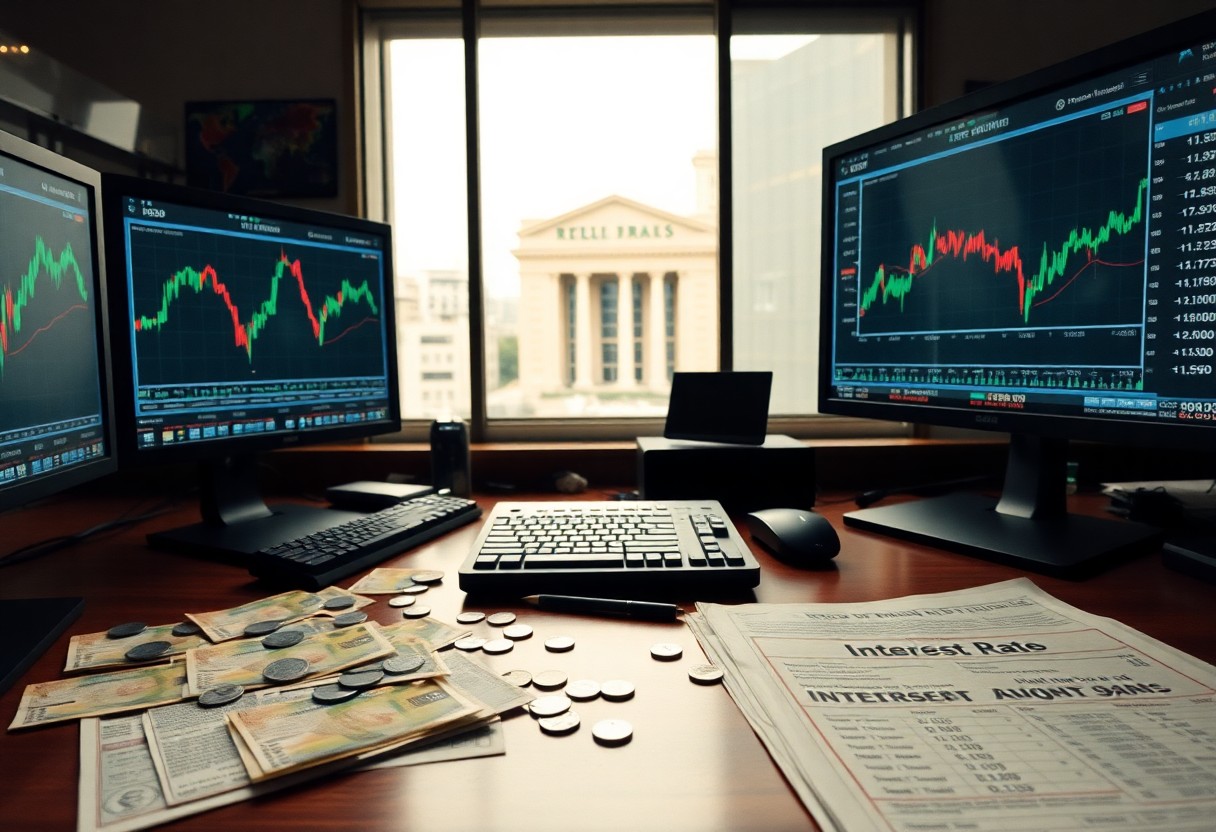
Most of your daily rupee moves are driven by a mix of macroeconomic data, RBI policy signals, interest-rate differentials, inflation trends, trade balances and foreign capital flows; you should also track forex reserves, crude prices and geopolitical developments because their interplay shapes market sentiment and volatility, allowing you to better time interventions, hedge exposures and interpret short-term exchange-rate shifts.
Key Takeaways:
- Monetary policy and interest-rate differentials – RBI stance versus Fed rates drives capital flows and carry trades, influencing INR appreciation or depreciation.
- Trade balance and commodity prices – India’s large oil and commodity import bill creates persistent dollar demand; rising oil prices or wider trade deficits tend to weaken the rupee.
- Capital flows and global risk sentiment – FPI/FDI movements, driven by global risk appetite and US Dollar strength, cause large daily swings in the FX market.
- RBI interventions and reserves – spot/forward interventions, reserve management and regulatory measures are used to smooth volatility and affect short-term exchange-rate direction.
- Domestic macro data and expectations – inflation, GDP, fiscal policy, corporate hedging and key economic releases shape intraday volatility and medium-term FX trends.
Overview of Foreign Exchange Rates
Daily INR quotes reflect the net outcome of trade flows, portfolio moves, commodity prices, and policy shifts; you watch them because a one-percent rupee change can alter import costs and corporate earnings materially. For instance, higher crude prices and FII outflows pushed the rupee weaker in 2022, while strong service exports and RBI dollar purchases supported it at other times, so short-term swings often track specific headlines and measurable capital flows rather than long-term fundamentals alone.
Definition and Importance
An exchange rate is the price of one currency in terms of another, and you should treat it as a key transmission channel for macro shocks: it affects inflation, corporate FX exposures, and the competitiveness of exports. In India, where you rely on imports for oil and key intermediates, even modest currency moves feed into headline inflation and corporate margins, so monitoring daily rates helps you manage hedges and assess monetary-policy tilt.
Role of Central Banks
Central banks like the RBI actively smooth excessive volatility, and you see this via spot interventions, FX swaps, and forward guidance; RBI’s reserves-over $500 billion-give it firepower to sell or buy dollars when markets overreact. During episodes such as the COVID shock and the 2022 global tightening, RBI stepped in to provide dollar liquidity and stabilize FX forwards, directly affecting your hedging costs and short-term rupee trajectory.
More technically, RBI uses a mix of tools-spot market trades, FX swaps to inject or absorb dollars, and sterilized OMOs to neutralize liquidity impact-so you should note how these operations change domestic interest rates and cross-currency basis. For example, increased FX-swap use eases dollar stress for banks, narrows forward premia, and reduces the incentive for aggressive currency carry trades, which in turn moderates intraday INR moves you trade or hedge against.
Economic Indicators
You track a handful of high-frequency indicators that move the rupee: monthly CPI and WPI prints, quarterly GDP, trade and current account balances, PMI and industrial output. When GDP growth slows from, say, 7% toward 5%, or the trade deficit widens sharply, foreign investors reassess earnings and reposition, prompting immediate FX volatility. Monthly surprises and revisions often matter more than annual averages for your intraday and daily FX decisions.
Inflation Rates
You watch CPI closely because the RBI’s inflation target is 4% with a ±2% tolerance band; a CPI print above 6% raises odds of rate hikes. Core inflation surprises – for example a 50 basis-point upside surprise – can trigger bond selloffs, attract foreign inflows into higher-yielding instruments, and support the rupee short-term as expectations for tighter policy rise.
Interest Rates
Your assessment of interest-rate differentials – RBI repo versus US federal funds and 10-year G‑sec versus 10‑year Treasury yields – drives carry trades and portfolio flows. A 25 basis-point RBI cut or a surprise Fed hike shifts short-term capital; banks and FX forwards reprice quickly, widening onshore-offshore spreads and moving the INR within hours.
Mechanically, you see repo/LAF tweaks, OMOs and CRR/SLR changes alter domestic liquidity and term premium: an RBI OMO injecting liquidity can lower short-term rates and weaken the rupee, while a sterilized FX intervention supports it. Hedge flows via FX swaps and forward covers spike around rate surprises, so monitoring RBI minutes and central bank press conferences gives you a trading edge.
Political Stability and Events
Elections, coalition shifts and high-profile policy moves – for example, the November 2016 demonetisation and the 2017 GST rollout – trigger immediate FX reactions you can trade around; markets priced the rupee more volatile during the 2019 general election season and again in 2020 amid pandemic policy shocks, so you watch event calendars and RBI statements closely to time interventions or hedge exposures.
Government Policies
When the government alters fiscal targets, announces tax reforms (such as the September 2019 corporate tax cut) or tweaks FPI/FDI rules, you see capital flows reprice quickly; a wider-than-expected budget deficit often weakens the rupee while incentives for manufacturing or relaxed FPI access can attract dollars and strengthen it.
Geopolitical Factors
Border skirmishes (June 2020 Galwan) and the Russia-Ukraine war from 2022 have shown you how supply shocks and sanctions translate into higher oil prices and import bills, pressuring the rupee; elevated global risk aversion during such episodes drives outward portfolio flows and larger NDF volatility that you must monitor.
- Election timetables: pre-election spending and coalition risk raise short-term volatility you can hedge with forwards.
- Policy surprises: unexpected subsidy cuts or tariff changes can flip market sentiment within hours.
- The impact of FX reserves: RBI intervention capacity alters how persistent those moves become.
In practice you’ll note that geopolitical shocks amplify existing vulnerabilities – for example, a crude spike after sanctions or supply-chain disruption forces larger import bills and faster reserve depletion, prompting the RBI to sell dollars or widen the volatility corridor while NDF spreads widen and hedging costs rise.
- Trade disruptions raise import costs and can widen the current account deficit you monitor daily.
- Sanctions and partner-country restrictions channel trade through alternate routes, affecting rupee liquidity.
- The linkage between commodity shocks and capital-flow reversals often determines the magnitude of rupee moves.

Market Sentiment
Sentiment often magnifies technical and macro signals: when you see FPIs reduce equity exposure or US yields jump 25-50 bps, USD/INR can gap 0.5-1% intraday. You watch onshore and offshore flows, option skew, and headlines; a rapid rise in implied volatility or a flurry of stop-loss orders typically tightens liquidity, widens bid-ask spreads, and forces faster RBI or bank responses than fundamentals alone would suggest.
Investor Behavior
Your asset-allocation shifts – retail buying, domestic institutions increasing bond exposure, or FPIs selling equities – directly affect FX demand. For example, when FPIs net-sell $2-3 billion in a week, you often see a corresponding dollar demand spike and rupee weakness. You track daily FPI flow, corporate import hedging, and bank interbank positions to anticipate direction and gauge how persistent moves might be.
Speculation Impact
Speculative positioning amplifies short-term moves: rising futures open interest or a sudden skew in options can signal leveraged long-dollar bets that push the rupee 1-2% on news. You monitor NDF premiums and one-month implied-volatility shifts as early warning signs of speculative pressure and potential rapid reversals when stops unwind.
Drilling deeper, you should watch metrics: a doubling of 1-month implied vol or a 20-30% jump in futures open interest ahead of policy or US CPI often precedes outsized INR moves. Proprietary desks and algorithmic funds use tight stop levels; when those are hit, short-covering can escalate an initial 0.5% move into 1.5%+ within hours. You can use option skew, put-call ratios, and time-stamped order-flow to identify crowded trades and pre-position hedges accordingly.
Global Economic Factors
Global shocks – central bank cycles, oil swings and trade disruptions – feed directly into daily INR moves. Key transmission channels include:
- US Fed policy and rate surprises
- Brent oil and commodity price spikes
- China growth and supply-chain slowdowns
- Geopolitical flare-ups that tighten risk appetite
- Cross-border liquidity and dollar funding strains
Perceiving how each channel shifts capital flows helps you size hedges and adjust FX exposure.
International Trade
You monitor goods and services flows because a widening merchandise deficit or oil bill jump pressures the rupee; for example, Brent surged above $100/barrel in 2022, amplifying import costs and CAD stress. Services exports – IT and remittances – often offset goods gaps, cushioning the INR, so you watch monthly trade prints, shipping disruptions and port congestion to anticipate short-term FX swings.
Foreign Investment
When FPIs reverse, you see prompt INR effects: sizable FPI outflows around the 2022 Fed hiking cycle coincided with sharp rupee depreciation and bond yield volatility, while steady FDI provides longer-term support. You track daily FPI flows, sovereign yield spreads and announced equity placements to gauge immediate pressure on FX markets.
Digging deeper, you separate portfolio flows (FPIs) from long-term FDI: FPIs react to rate differentials and risk, often moving tens of billions across months, while FDI commitments change slowly but alter the current account over years. You also watch central bank reserve usage, RBI bond purchases and corporate external commercial borrowings – combined signals that tell you whether capital flow shifts will be transient or structural.
Technological Advancements
Latency reductions, cloud analytics and tick-by-tick data feeds have compressed reaction times for INR moves; co-location and FIX/API access cut order-to-execution from seconds to sub-millisecond for some participants, while real-time news feeds from Refinitiv and Bloomberg let you price in macro shocks instantly. As a result, microstructure – order-book depth, API throttles and exchange margin calls – now shapes intraday USD/INR swings as much as headline macro prints.
Trading Platforms
Interbank spot liquidity remains concentrated on platforms like Refinitiv Matching and EBS for large banks, while NSE and BSE channels handle exchange-traded currency futures and options; retail brokers (ICICI, HDFC, Kotak and others) layer on APIs and mobile UIs so you can access depth, historical ticks and algorithmic hooks. Platform choice affects execution quality: depth, latency, FIX support and co-location options determine slippage and implied costs.
Algorithmic Trading
Algorithmic strategies – market-making, statistical arbitrage, VWAP/TWAP execution and latency-sensitive signals – now account for a large share of electronic volumes (equities >40% historically) and are growing in currency futures, so you encounter tighter but more reactive spreads and faster order book replenishment during normal conditions.
When you deploy or face algos, expect pre-trade risk controls, kill-switches and exchange-level throttles; firms run robust backtests, Monte Carlo stress tests and use co-location to shave microseconds. Arbitrage between USD/INR spot, futures and NDFs is commonly automated, compressing inefficiencies to basis moves under a few paise most days, but during dislocations (eg. March 2020) algos can exacerbate intraday volatility and widen spreads rapidly unless liquidity providers step in.
To wrap up
To wrap up, you should track RBI policy moves, interest-rate differentials, inflation and GDP data, trade and capital-flow balances, FII activity and USD momentum, crude-oil and commodity swings, and global risk sentiment; these factors interact daily to shape INR volatility, so you can anticipate likely direction by monitoring data releases, central-bank signals, market positioning, and geopolitical developments.
FAQ
Q: What domestic economic and policy factors most directly influence daily foreign exchange rates for the Indian rupee (INR)?
A: Daily INR moves respond quickly to Reserve Bank of India (RBI) actions and signals (repo rate changes, open market operations, spot interventions, swap lines), because these affect interest rate differentials and onshore liquidity. Key macro data releases – inflation, industrial production, trade balance and GDP growth – shift expectations about monetary policy and capital flows. Fiscal developments (budget deficits, large government borrowing) and changes in FX reserves also matter because they alter perceived supply/demand for dollars. Corporate flows from large import or export settlements, remittances and seasonal import demand (energy, gold) create predictable intra-month pressures. Market microstructure items such as transaction costs, banking hour liquidity, and the onshore forward and options market determine how quickly information is translated into spot moves.
Q: How do global factors and commodity prices affect daily INR volatility and direction?
A: The INR is sensitive to global risk sentiment and major currency moves, especially USD strength driven by U.S. Fed policy and U.S. macro data; a stronger dollar typically pressures the rupee. Crude oil price swings have an outsized effect because India is a large net importer of oil – rising oil increases import bills and current account pressure, weakening INR. Global equity and bond flows (foreign institutional investor activity) shift capital into or out of India on a daily basis, producing rapid FX flows. Geopolitical shocks, sudden changes in global liquidity, and cross-border regulatory announcements can trigger immediate currency re-pricing. Correlations with other emerging market currencies mean contagion from other EM stress events can move the rupee even without India-specific news.
Q: What role do market participants, hedging activity and technical factors play in day-to-day rupee movements?
A: Banks, corporates, exporters, importers, asset managers and speculators each create flows that determine intraday direction: exporters selling dollars, importers buying dollars, FIIs repatriating funds, and proprietary desks taking positions all impact spot liquidity. Hedging via forwards and options alters effective demand – heavy forward buying by importers or margin-driven option positioning can amplify moves. Technical factors such as order concentration at round levels, stop-loss cascades, and algorithmic trading can produce sharp intraday swings even on modest news. The RBI’s known intervention patterns and the daily reference rate (FBIL/FIMMDA benchmarks) influence end-of-day positioning and settlement behavior. Timed macro releases, market holidays in major centers, and settlement cycles frequently explain why some days are more volatile than others.