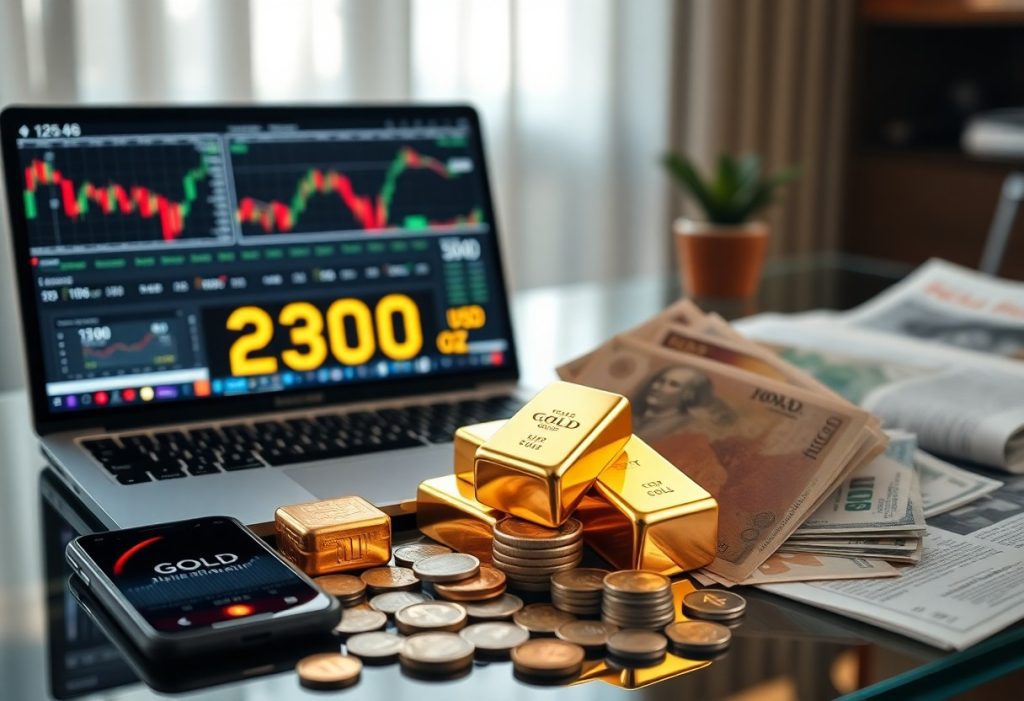

You are witnessing rising gold prices in India and need clear guidance to protect your savings and enhance returns; this post explains factors driving the surge and practical alternatives-sovereign gold bonds, gold ETFs, systematic equity and debt investments, and diversified mutual funds-so you can weigh liquidity, tax implications, and risk to make informed, strategic choices for your portfolio.
Current Trends in Gold Prices in India
You’re seeing gold maintain an upward bias driven by a mix of domestic demand resilience and external shocks. Over the last few years bullion has reacted to interest-rate cycles, geopolitical flare-ups and periodic rupee weakness, which together have pushed local 24K prices higher at several points; for example, the global spike near USD 2,000/oz in 2020 translated into Indian retail quotes that moved past typical ranges and forced investors to reassess allocation size. Trading volumes on major Indian exchanges and physical demand around festival/wedding seasons have amplified short-term moves, so your timing and liquidity needs matter more than they did in calmer cycles.
Volatility remains a feature you must manage: intra-year swings of 8-15% are not uncommon as rate expectations and dollar strength flip. You’ll notice that breakouts on global charts often get magnified domestically when the rupee slips, because a 1-2% depreciation can add a comparable percentage to rupee-priced gold instantly. That means you can’t treat global and local price charts in isolation if you’re planning buys, sales or hedges.
Historical Price Movements
You can trace the modern trajectory from the 2008-2011 bull run (when gold in dollars hit multi-year highs) through the sharp corrections after policy shocks, and into the pandemic-era rally that set fresh records. Historically, India’s price behavior has mirrored global cycles but with steeper local spikes during import-cost shocks: when the rupee weakens or import duties shift, domestic prices have shown outsized upward moves versus dollar gold. Past events-like the 2008 financial crisis and the 2020 pandemic-offer clear examples of how safe-haven flows and central-bank actions translate quickly into higher local premiums.
When you compare multi-year charts, you’ll find two patterns: secular appreciation mixed with episodic volatility. Long-term buying during low-rate regimes preserved purchasing power for many investors, while short-term speculators exploited 10-20% retracements. If you’re evaluating past performance to shape strategy, focus on how price spikes correlated with liquidity squeezes and policy responses rather than assuming steady compounding returns.
Factors Driving Price Increases
You should weigh both domestic and international drivers: global monetary policy (especially Fed positioning), sustained central-bank purchases, and geopolitical tensions lift the safe-haven bid, while Indian-specific factors-wedding and festival demand, import duty/tax structure, and rupee fluctuations-add local momentum. For context, India accounts for roughly one-fifth to one-quarter of annual physical demand globally, so shifts in Indian consumer behavior can materially affect price direction. When central banks add hundreds of tonnes to reserves, that structural demand supports higher baselines for prices you watch.
Supply-side elements also matter to your thesis: mine output growth is slow and concentrated, while recycling responds to price levels and household economics, meaning supply elasticity is limited. That limited responsiveness can magnify price moves when demand surges; for instance, a jump in wedding-season buying combined with a weaker rupee tends to push local premiums north of global spot moves. You’ll find that policy moves-changes in import duty or stock limits-have repeatedly altered domestic spreads and dealer inventories, affecting your transaction costs.
- Global monetary shifts: Fed rate cuts or dovish signaling historically buoy gold by reducing real rates and increasing appetite for non-yielding assets.
- Central-bank buying: emerging-market banks have added hundreds of tonnes in recent years, tightening the available supply and supporting prices.
- Domestic demand surges: wedding seasons and festivals can account for large monthly consumption spikes, especially in key buying states like Gujarat and Rajasthan.
- Currency moves and taxes: import duties, GST and a weakening rupee push local prices above international levels, raising your effective cost.
- Knowing how these factors stack in a given quarter helps you decide between staged buying, fixed-dollar cost averaging, or short-term hedging.
You’ll want to monitor leading indicators: real rates, central-bank reserve flows, and rupee trajectory provide early signals whether the current upmove has momentum. For example, if you see gold rising while real yields fall and the RBI’s balance-sheet growth slows, that combination often precedes further gains; conversely, a sharp, coordinated dollar rally plus a surprisingly hawkish Fed meeting can reverse momentum quickly. Use these inputs to size positions and set stop/investment thresholds aligned with your time horizon and liquidity needs.
- Track real interest rates and CPI surprises for early clues on demand for non-yielding stores of value.
- Watch import and customs data-spikes in import bills or temporary duty changes often presage higher local premiums.
- Follow bullion flows into ETFs and central-bank reports to gauge structural versus tactical demand.
- Knowing how these data points converge in the short term will improve your entry and exit timing.
Impact of Rising Gold Prices on the Economy
Rising gold prices raise your country’s import bill sharply because India imports most of the metal; with annual gold imports often exceeding $40 billion, a 10% price increase can add roughly $4 billion to the current account outflow, tightening external balances and forcing policymakers to adjust. At the same time, higher gold valuations shift household wealth composition, moving savings away from cash and bank deposits into physical gold, which alters liquidity patterns you see in rural and urban credit cycles.
Policy responses you encounter include greater use of instruments such as import restrictions, higher customs duties or incentivising financial alternatives (Sovereign Gold Bonds, gold ETFs) to curb physical demand; these measures aim to limit pressure on foreign exchange reserves while preserving domestic investment avenues without stalling festival and wedding-season purchases that still account for a large share of annual jewellery demand.
Influence on Inflation and Currency Value
You should view gold both as an inflation hedge and as an import-driven inflation pressure: rising global gold feeds into higher local prices for jewellery and coins, modestly influencing the consumer price index components tied to household spending. Because India imports the metal, price jumps translate directly into a larger import bill; for example, if imports are $40 billion, a 10% price rise means about $4 billion extra outflow, which can feed through to currency depreciation and imported inflation for other commodities when forex weakens.
When the rupee weakens against the dollar, you face a two-way effect-gold becomes more expensive in rupee terms even if dollar gold is stable, and that pass-through can nudge headline inflation upward by raising discretionary spending costs. In practical terms, you may see central banks tighten liquidity or governments alter tariffs to defend the currency and limit secondary inflationary effects, as happened in episodes where sustained demand and price spikes widened the current account deficit.
Shift in Consumer Buying Patterns
Consumers you deal with increasingly adjust purchase behaviour: there is a clear move from bulk purchases of 8-20 gram pieces to lightweight designs and fractional coins in the 0.5-5 gram range, reflecting affordability pressures. Jewellery retailers report stronger demand for lightweight chains, thin bangles and small coins, while you as a buyer are more likely to delay big ceremonial purchases or split them across months to average costs.
At the same time, adoption of financial gold alternatives has accelerated; digital gold platforms and gold ETFs let you buy fractional gold with minimum investments typically in the low hundreds of rupees, and Sovereign Gold Bonds continue to attract investors seeking income and capital gains without the making charges and storage risks of physical metal. These channels shift demand from physical inventory to paper/digital holdings, changing how jewellers price items and manage stock.
For your planning, that means manufacturers and retailers innovate with lower-making-charge collections, buy-back guarantees and monthly instalment schemes to retain customers; you will find more retailers offering certified 0.5-2 gram coins and app-based purchase options, making it easier to maintain gold exposure while smoothing the impact of volatile spot prices on your household budget.
Traditional Investment In Gold
India’s affinity for gold still shows up in household balance sheets: annual demand has historically ranged in the several hundred tonnes, driven by weddings, festivals, and savings behavior. You rely on gold not only for adornment but also as a store of value and a hedge against currency volatility, which explains why physical buying and paper products coexist in most portfolios.
That said, traditional routes carry visible costs and frictions. You face purity variations, making charges, storage risks and resale discounts that can erode returns; those factors make it important to weigh the immediate emotional or cultural benefits of jewellery against the effective investment return after costs.
Physical Gold Purchases
Buying jewellery, coins or bars means choosing between 24K (about 99.9% pure) and 22K (about 91.6% pure) standards; each choice affects resale value and wearability. You typically pay making charges that range widely-commonly 5-15% for simple designs and higher for intricate workmanship-so a ₹100,000 invoice can translate into a significantly lower recovery when you sell.
Storage and liquidity are practical concerns: you must secure safe custody-bank lockers or insured home safes-and accept that resale often occurs at a dealer discount to the spot rate. For example, coins and standard bars usually attract smaller discounts on sale than designer jewellery, so if you want quicker, nearer-spot liquidity, bullion rounds or BIS-hallmarked coins are more efficient than ornate pieces.
Gold ETFs and Mutual Funds
Gold ETFs let you buy units that track the domestic gold price without taking delivery; you hold them in demat accounts and can transact intraday on exchanges. You avoid making charges and storage headaches, and you typically face fund expense ratios in the 0.2%-0.8% band, with liquidity and spreads that vary by the ETF’s average daily volume.
Gold mutual funds generally invest in gold ETFs or in sovereign gold bonds and aim to give you pooled exposure with systematic investment plan (SIP) convenience and professional management. You should monitor tracking error-many leading ETFs keep annual tracking error below 0.5%-because that determines how closely your fund mirrors bullion performance.
For additional context, compare ETFs and mutual funds with Sovereign Gold Bonds (SGBs): SGBs pay a fixed interest (recent tranches offered around 2.5% p.a.), have an 8-year tenor with an exit option from year 5, and are issued by the government-so you get interest plus price appreciation but interest is taxable. You benefit from lower custody costs and clearer taxation on long-term holdings by choosing ETFs or SGBs over physical gold when your goal is investment efficiency rather than jewellery ownership.
Smart Investment Alternatives
Stocks in Gold Mining Companies
You can gain leveraged exposure to rising gold prices by buying shares of major miners such as Newmont, Barrick, Agnico Eagle and Gold Fields, or through sector ETFs like GDX (large-cap miners) and GDXJ (junior miners). Mining equities typically amplify bullion moves – industry analysis shows miners can move roughly 1.5-3x the percentage change in the gold price because margins expand when prices rise and compress when they fall.
When you evaluate miners, focus on metrics such as all-in sustaining costs (AISC, often in the $900-$1,300/oz band for many large producers), reserve life, and regional political risk; a low AISC and long reserve life tend to protect margins. You should also weigh corporate balance sheets and capital expenditure plans, since high debt or aggressive project spending can erode gains even during bull runs.
Real Estate as a Hedge Against Inflation
You can use real estate to preserve purchasing power by targeting commercial assets or REITs rather than only residential flats, because office and retail properties in India commonly deliver higher rental yields – typically 6-8% gross for commercial versus 2-3% for residential in major metros. Listed REITs such as Embassy Office Parks, Mindspace and Brookfield India REIT give you liquidity, professional asset management and dividend-like rental income without the hassles of direct ownership.
When you assess property exposure, consider location-specific demand drivers (IT/finance hubs, logistics corridors), vacancy and occupancy trends, and lease structures; commercial leases often include annual escalations and longer contract terms that help incomes keep pace with inflation. Also factor transaction costs, stamp duty and the time it takes to realize capital gains when comparing real estate to more liquid inflation hedges.
For more hands-on details, you should check REIT balance sheets for occupancy rates (above 85% is healthy), weighted average lease expiry (WALE) and tenant concentration; strong WALEs and diversified tenant bases reduce short-term cashflow volatility. You may also use mortgage leverage selectively – modest gearing can boost long-term returns but raises sensitivity to rate hikes, so model scenarios with a 200-500 bps rise in borrowing costs to see the impact on your yields.
Assessing Risk and Diversification Strategies
Your exposure to gold should be evaluated against both market and personal risk parameters: volatility, liquidity needs, tax implications, and investment horizon. Physical gold can carry upfront costs-making charges on jewellery often range from 6% to 12% of the metal value, while coins and bars typically carry a 1-3% premium-whereas Sovereign Gold Bonds (SGBs) pay a fixed 2.5% annual interest and have an eight-year maturity with an exit option from year five. Factor in these idiosyncratic costs when calculating expected returns and comparing them with nominal yields from fixed deposits, PPF, or high-quality debt funds that historically deliver steady income with lower price swings.
Given gold’s historical tendency to behave differently from equities and bonds during periods of stress, you should treat it as a hedge and a portfolio-stabiliser rather than a primary growth engine. Use concrete allocation rules: many advisors suggest a baseline gold allocation of 5-10% for long-term investors, raising it tactically to 10-15% if you anticipate high inflation or geopolitical risk. Track performance and implement rules-based rebalancing-if your target is 8% and gold rises to 13%, that 5 percentage-point drift is a signal to trim and redeploy into underweight asset classes.
Balancing Gold Investments with Other Assets
You can combine gold with equities, fixed income, and real assets to reduce portfolio drawdowns while preserving upside. For example, a conservative core-satellite mix might hold 40-60% in diversified equity index funds, 25-35% in debt instruments (bank FDs, debt funds, EPF/PPF equivalents), and 5-10% in gold exposure split between SGBs (for the coupon and tax benefits if held to maturity) and Gold ETFs (for intraday liquidity). If you have a 10 lakh portfolio and choose an 8% gold allocation, that translates to 80,000 INR-consider allocating 40,000 INR to SGBs and 40,000 INR to Gold ETFs to balance yield, liquidity, and cost.
When you adjust weighting, pay attention to tax and transaction differences: long-term capital gains on SGBs held to maturity can be tax-efficient compared with physical resale, and Gold ETFs trade like equities with low tracking error but may involve annual expense ratios of 0.2-0.5%. Use these characteristics to match instruments to objectives-SGBs for buy-and-hold, ETFs for tactical trades, and physical gold for legacy or gifting purposes where cultural value matters more than returns.
Building a Resilient Portfolio
Start by defining a core allocation aligned to your risk tolerance-typical templates put equities at 40-60%, debt at 25-40%, and alternatives including gold and real estate at 5-15%-then implement a disciplined rebalancing policy, such as annual review or a 5% band rebalancing trigger. You should also maintain 6 months of living expenses in liquid instruments (savings account, ultra-short-term funds) to avoid forced selling during market turbulence; this preserves your strategic asset mix and lets gold perform its hedging role when equity markets correct.
Use a core-satellite approach to increase resilience: keep low-cost index funds and conservative debt as the core, while allocating a smaller satellite portion to tactical gold positions, niche credit funds, or small-cap equity opportunities. If you face acute inflation risk, you might tactically raise gold to 12-15% for a limited period, then systematically pare back as inflation expectations normalise. Implement stop-loss and profit-booking rules for your satellite bets to prevent emotional derailing of the core plan.
To operationalise this, set clear thresholds and execution plans-for example, rebalance when any asset class drifts by more than 5%, allocate incoming savings pro rata to underweight buckets, and prefer automated SIPs for equities and ETFs to enforce discipline; these simple rules reduce behavioural errors and keep your portfolio aligned with long-term goals.
Summing up
As a reminder, rising gold prices in India change the investment landscape for you: gold can protect purchasing power during inflation and act as a safe-haven, yet it also carries price volatility, storage and purity concerns, and opportunity cost compared with other assets. You should assess your investment horizon, liquidity needs and tax implications before increasing exposure to physical gold, and avoid concentrating your portfolio in a single commodity.
To invest smartly, consider alternatives that fit your risk profile and objectives – Sovereign Gold Bonds for interest and tax benefits, gold ETFs and digital gold for liquidity and low custody costs, and diversified equity or hybrid mutual funds for higher long-term return potential. Balance allocations across these options, use SIPs or staggered purchases to manage timing risk, and rebalance your portfolio periodically to keep your strategy aligned with your goals and risk tolerance.
FAQ
Q: Why are gold prices rising in India?
A: Several factors drive recent rises: global safe-haven demand amid economic uncertainty, low or uncertain real interest rates that reduce opportunity cost of holding gold, and expectations of monetary easing by major central banks. Domestically, a weaker rupee increases local prices for imported gold, while seasonal and wedding demand boosts consumption. Central bank purchases and limited mine supply also tighten global availability, supporting higher prices.
Q: Should I buy physical gold or opt for alternatives like Sovereign Gold Bonds, ETFs, or digital gold?
A: Choice depends on objectives. Physical gold (jewellery, coins, bars) offers tangible ownership and cultural value but incurs making charges, storage costs, and insurance risk. Sovereign Gold Bonds (SGBs) pay periodic interest, have lower custody risk, and offer capital gains tax benefits on redemption if held to maturity, though interest is taxable. Gold ETFs and gold mutual funds are liquid, cost-efficient, and easy to trade, with no storage hassles; they attract capital gains tax rules similar to other financial assets. Digital gold is convenient for small purchases but carries custodian risk and possible premiums. Gold mining stocks or commodity derivatives add leverage and corporate/market-specific risks and suit experienced investors. Compare costs, liquidity, tax treatment, and risk before choosing.
Q: How should I position my portfolio while prices are rising? Tactical steps and allocation advice?
A: Define the role of gold (hedge, diversification, speculation). For diversification, many advisers recommend 5-10% of portfolio value in gold for conservative investors and 5-15% for moderate investors; aggressive investors may keep a smaller allocation. Use staggered purchases or SIPs in gold ETFs to average entry price rather than lump-sum at peaks. Prefer SGBs or ETFs for core holdings due to lower carrying costs and clearer tax treatment; keep physical gold for cultural needs. Set target entry/exit levels, rebalance periodically, and avoid emotional buying driven solely by headlines. Factor taxes: long-term treatment (indexation) typically applies after 36 months for ETFs/mutual funds/physical gold, while SGBs offer favorable redemption tax treatment if held to maturity; interest on SGBs is taxable. Assess costs, counterparty and storage risks, and align choices with your time horizon and liquidity needs.