
Foreign currency exchange in Chennai covers two everyday needs: buying foreign currency before you travel and selling it back when you return. Both are regulated by the Reserve Bank of India (RBI) under the Foreign Exchange Management Act (FEMA), so the process is fairly standard wherever you go: you show your documents, agree a rate, pay, and get a receipt. What changes from provider to provider is the rate, the charges, the currencies in stock and the convenience.
This guide walks through the whole process for Chennai residents and visitors, from choosing where to exchange to what happens after your trip.
Who Can Exchange Foreign Currency in Chennai?
- Residents travelling abroad can buy foreign currency for private visits, business trips, studies, medical treatment and other permitted purposes under the Liberalised Remittance Scheme (LRS).
- Residents returning from abroad can sell unused foreign currency back to an authorised provider.
- Foreign visitors can convert their currency into rupees at authorised money changers and banks.
Where to Exchange: Your Options in Chennai
| Option | Good for | Keep in mind |
|---|---|---|
| Banks | Customers who already bank there; remittances | Some branches stock only major currencies |
| Authorised money changers (FFMCs) | Quick purchase and buyback of cash, travel cards | Compare the final amount between providers |
| Online forex platforms | Comparing quotes from home | Delivery and pickup rules vary |
| Airport counters | Last-minute top-ups | Usually more expensive than city providers |
Full-fledged money changers are licensed by the RBI to buy foreign exchange from residents and visitors and to sell it for private and business travel. The RBI publishes the list of authorised money changers by region. For a checklist of what to look for, read our guide on how to choose the best money changer in Chennai.
Step-by-Step: Buying Foreign Currency for a Trip
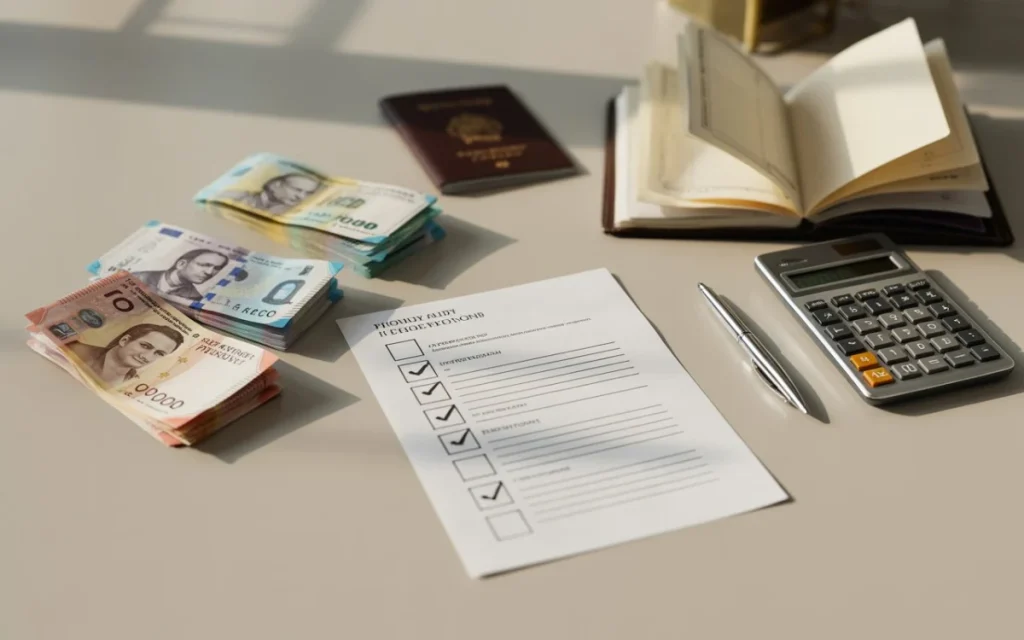
- Work out how much you need. Estimate daily spending and decide how much will be cash and how much will go on a travel card.
- Check the cash limit. For most countries you can buy up to USD 3,000 (or equivalent) in notes per visit (RBI FAQ).
- Call ahead. Confirm the currency is in stock and ask for the selling rate and final rupee amount.
- Bring your documents. Usually your passport, visa (where applicable), air ticket and PAN card.
- Pay the right way. Cash is allowed only below ₹50,000; larger amounts must be paid by cheque, draft, pay order or card.
- Check and count. Inspect the notes at the counter and keep the receipt.
The best time to buy currency is a few days before you fly, not at the airport. You get time to compare and to order anything unusual.
Currencies Chennai Travellers Commonly Need
Chennai’s airport connects to the Gulf, Southeast Asia, Europe and beyond, so the most requested currencies include the US dollar, UAE dirham, Singapore dollar, euro, British pound, Saudi riyal, Malaysian ringgit, Thai baht, Australian dollar and Canadian dollar. Major currencies are usually available on the spot; others may need to be ordered.
Rates, Charges and Tax
Buying and selling rates
Every provider quotes a selling rate (what you pay for foreign currency) and a buying rate (what you get when you sell it back). The difference between them is the provider’s margin. Our explainer on buying versus selling rates shows how this works with examples.
GST and service charges
GST applies to the value of currency conversion services, and some providers add a service charge. Always ask for the all-in rupee amount.
TCS
Tax Collected at Source applies only once your total LRS purchases in a financial year cross ₹10 lakh. For travel forex the rate is 20% on the amount above that threshold; overseas tour packages attract 2% from the first rupee (IndusInd Bank). TCS can be claimed back when you file your income tax return.
Selling Foreign Currency After Your Trip
RBI rules require residents to surrender unspent foreign currency notes and travellers’ cheques within 180 days of returning, though you can keep up to USD 2,000 (or equivalent) for future trips and any amount in coins. To sell, bring your passport and the original purchase receipt if you have it. Our guide on exchanging unused foreign currency covers this in detail.
Common Mistakes to Avoid
- Buying all your currency at the airport
- Carrying more cash than the per-visit limit allows
- Forgetting your PAN card or passport
- Accepting torn or marked notes
- Not keeping receipts
- Dealing with unauthorised individuals offering better rates
Exchanging Currency With GEM Money Changers in Chennai
GEM Money Changers’ Chennai branch is at 110, Sir Thyagaraya Road, Parthasarathi Puram, T. Nagar. The team handles foreign currency purchase and buyback, travel cards and help with international payments for travellers, students and businesses. See our Chennai currency exchange page for services and directions.
Planning a trip from Chennai?
Call us with the currency and amount you need and we will confirm availability and today’s rate.
Frequently Asked Questions
Where can I exchange foreign currency in Chennai?
At banks, RBI-authorised money changers, online forex platforms and airport counters. Authorised money changers in the city usually offer the widest currency range for travellers.
What documents are needed for currency exchange in Chennai?
For buying currency you usually need your passport, a valid visa where applicable, your air ticket and your PAN card. For selling, bring your passport and the purchase receipt if available.
How much foreign currency can I buy in cash?
Up to USD 3,000 or its equivalent per visit for most countries. Iraq and Libya allow up to USD 5,000, and travel to Iran, Russia and other CIS countries allows the full amount drawn.
Is GST charged on currency exchange?
Yes, GST applies to the value of the currency conversion service. Ask your provider for the final amount including GST and any service charge.
Can foreign tourists exchange money in Chennai?
Yes. Visitors can convert foreign currency into rupees at banks and authorised money changers by showing their passport.
Sources
- Reserve Bank of India: FAQ on miscellaneous forex facilities
- Reserve Bank of India: List of full-fledged money changers
- Reserve Bank of India: Master Direction on Other Remittance Facilities
- IndusInd Bank: TCS on foreign remittance under LRS
This article is general information, not financial or tax advice. Confirm current requirements with an authorised provider. Last reviewed: November 2026.