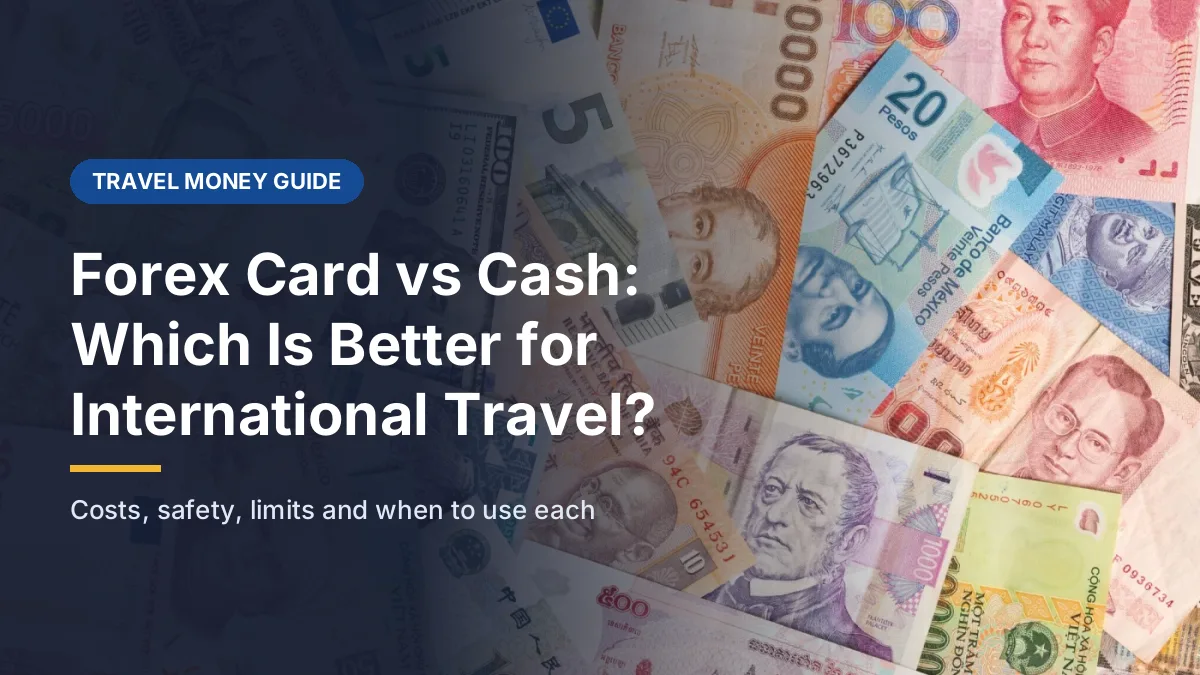
For most international trips, the best answer is not forex card or cash but a mix of both: a forex card (also called a prepaid travel card) for hotels, shopping and ATM withdrawals, and a modest amount of foreign cash for taxis, tips and the first hours after landing. How you split the two depends on where you are going, how long you will stay and how you like to pay.
This guide compares the two side by side so you can decide what works for your trip.
What Is a Forex Card?
A forex card is a prepaid card loaded with one or more foreign currencies before you travel. You use it like a debit card abroad: at shops, restaurants, hotels and ATMs. Because the currency is loaded at a fixed rate on the day you load it, you know your budget in rupees before you leave. Multi-currency cards can hold several currencies at once, which helps on trips covering more than one country.
Forex Card vs Cash at a Glance
| Feature | Forex card | Foreign cash |
|---|---|---|
| Acceptance | Shops, hotels, online and ATMs that accept the card network | Everywhere, including small vendors and taxis |
| Safety if lost | Can be blocked and usually replaced | Lost cash is usually gone for good |
| Exchange rate | Locked when you load the card | Locked when you buy the notes |
| Limits | Within the overall LRS limit | Up to USD 3,000 (or equivalent) per visit for most countries |
| Extra costs to ask about | Issuance, reload, ATM and cross-currency charges | Margin between buying and selling rates |
| Leftover balance | Kept for the next trip or refunded | Sold back or kept within RBI limits |
Carry enough cash for your first day and for places that don’t take cards. Put the rest on a card you can block if it goes missing.
When a Forex Card Works Better
- Longer trips and students: you can reload the card from India instead of carrying large sums. Our guide for Indian students going to Canada shows how students combine cards and remittances.
- Card-friendly destinations: cities such as Singapore, Dubai and much of Europe accept cards widely.
- Budget control: you know exactly how much you have loaded, which makes spending easier to track.
- Security: a lost or stolen card can be blocked, protecting the balance.
When Cash Works Better
- Small payments: taxis, street food, local markets and tips are often cash-only.
- Arrival day: having local currency in hand before you clear the airport avoids expensive airport exchange.
- Places with patchy card acceptance: smaller towns and some countries still rely heavily on cash.
- Emergencies: cash works when card terminals or ATMs are down.
RBI Rules That Apply to Both
Foreign exchange for travel is bought under the Liberalised Remittance Scheme (LRS), which lets a resident individual use up to USD 2,50,000 per financial year for permitted purposes. Within that, the RBI limits physical notes to USD 3,000 (or equivalent) per visit for most countries, with higher limits for a few destinations (RBI FAQ). Anything above the cash limit can go on a forex card. For the full picture, read our guide on how much foreign currency you can carry from India.
Tax Collected at Source (TCS) applies to forex purchases (cash or card) only after your total LRS purchases in the financial year cross ₹10 lakh, at 20% on the amount above that for travel forex (IndusInd Bank on TCS). Most holidays stay below this threshold.
How to Decide Your Split
Use this as a starting point and adjust for your trip:
| Trip type | Suggested approach |
|---|---|
| Short holiday in a card-friendly city | Mostly card, with cash for the first day and small spends |
| Family trip with local travel | Card for hotels and shopping; more cash for taxis and markets |
| Business trip | Card for most expenses; a small cash float |
| Student starting a course | Card for the first weeks plus remittances for fees; limited cash |
| Gulf job or family visit | Cash for arrival needs; card or bank account for ongoing spends |
Questions to Ask Before You Buy
- What is the rate for loading the card, and what is the rate for cash today?
- Are there issuance, reload or ATM withdrawal charges?
- What happens if I spend in a currency not loaded on the card?
- How do I block the card and get a replacement abroad?
- How do I get the unused balance back after the trip?
If you come back with leftover notes, you can sell them to an authorised money changer. Our guide on exchanging unused foreign currency explains the rules.
Getting a Forex Card or Cash With GEM Money Changers
GEM Money Changers provides both travel cards and foreign cash from its branches in T. Nagar, Chennai and on Royals Road, Trichy. See our services for details, or visit the Chennai and Trichy branch pages.
Not sure how to split cash and card?
Tell us where you are going and for how long, and our team will help you plan your travel money.
Frequently Asked Questions
Is a forex card better than cash for international travel?
For most trips a combination works best: a forex card for larger and card-friendly payments, and some cash for taxis, tips and small vendors.
How much cash can I carry on a forex trip from India?
For most countries you can buy up to USD 3,000 or its equivalent in foreign currency notes per visit. The rest can be loaded on a forex card within the LRS limit.
Can I withdraw cash abroad with a forex card?
Yes, at ATMs that accept the card’s network. Ask your provider about ATM withdrawal charges before you travel.
What happens to the money left on my forex card?
You can keep it for a future trip or ask the provider to refund the balance to your bank account.
Is TCS charged on forex cards?
TCS applies to forex cards and cash alike, but only once your total LRS purchases in the financial year exceed ₹10 lakh.
Sources
- Reserve Bank of India: FAQ on miscellaneous forex facilities
- Reserve Bank of India: Master Direction on Other Remittance Facilities
- IndusInd Bank: TCS on foreign remittance under LRS
This article is general information, not financial advice. Card features and charges vary by provider; confirm them before you buy. Last reviewed: November 2026.