
Indian students going to Canada usually handle money in three stages: showing proof of funds for the study permit (often through a Guaranteed Investment Certificate, or GIC), paying tuition to the college or university, and arranging money for arrival and day-to-day living. All of it is sent from India under the Reserve Bank of India’s Liberalised Remittance Scheme (LRS), which allows up to USD 2,50,000 per person per financial year.
This guide walks through each stage, with a checklist you can follow before you fly.
Stage 1: Proof of Funds and the GIC
Immigration, Refugees and Citizenship Canada (IRCC) asks study permit applicants to show they can cover tuition, living costs and return travel. The minimum living-cost amount for a single student outside Quebec was CAD 22,895 for applications made before 1 September 2026, and a higher figure of CAD 23,448 has been reported for applications from that date (ApplyBoard). Quebec sets its own amount. Always check the current figure on IRCC’s website before you apply.
The Student Direct Stream (SDS) closed in November 2024, so Indian students now apply through the standard process. A GIC is no longer mandatory, but many students still use one because it is easy for officers to verify.
| What a GIC is | What to know |
|---|---|
| A deposit with a participating Canadian bank | Funded by an international transfer from India |
| Proof of living funds for the study permit | Part is usually released on arrival and the rest in monthly instalments |
| Your own money, not a loan | Refund rules apply if the visa is refused; check the bank’s terms |
Stage 2: Paying Tuition
Tuition is paid by international wire directly to the institution’s bank account, against its invoice or offer letter. Many colleges ask for the first year’s tuition, or a deposit, before issuing documents needed for the study permit. Our guide on overseas tuition fee payments explains the process, and this checklist covers the documents.
Send tuition and GIC money only to the institution’s or bank’s official account, confirmed on their own portal. Never route it through an agent.
Stage 3: Money for Arrival and Living Costs
| Option | Use it for | Notes |
|---|---|---|
| Canadian dollar cash | Arrival day, transport, small purchases | Within USD 3,000 (or equivalent) per visit for most countries |
| Travel (forex) card | First weeks before your bank account is set up | Reloadable from India |
| GIC instalments | Regular living costs | Released by the Canadian bank after arrival |
| Remittances to a Canadian account | Ongoing support from family | Sent under the sender’s LRS limit |
For the cash versus card decision, see forex card vs cash.
TCS for Canada-Bound Students
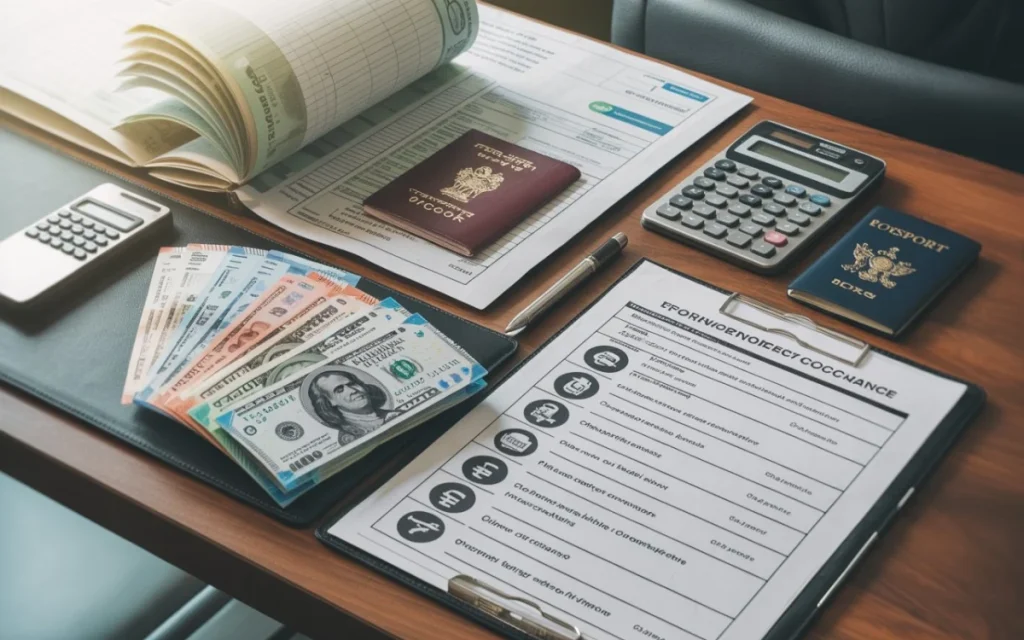
TCS applies only to the part of total LRS remittances in a financial year above ₹10 lakh. For education from your own funds it is 2% above that threshold since 1 April 2026, and nil when the remittance is funded by an education loan from a financial institution (IndusInd Bank). Because GIC deposits and tuition can together cross ₹10 lakh, mark each remittance with the education purpose so the correct rate applies. TCS can be claimed back when the remitter files an income tax return.
Pre-Departure Money Checklist
- Confirm the current proof-of-funds amount on IRCC’s website.
- Fund the GIC or prepare other proof of funds.
- Pay the tuition deposit or first-year fees to the institution.
- Keep SWIFT confirmations and receipts for your visa file.
- Buy Canadian dollar cash for arrival within the RBI per-visit limit.
- Load a travel card for the first weeks.
- Save card helplines and keep a backup card.
Documents You Will Typically Need for Remittances
- Student’s passport
- Letter of acceptance and fee invoice
- Remitter’s PAN card
- Form A2 and LRS declaration
- Proof of relationship if a parent is paying
- Loan sanction letter if the remittance is loan-funded
How GEM Money Changers Can Help
GEM Money Changers helps students and parents in Chennai and Trichy with student remittances for tuition and GIC funding, Canadian dollar cash and travel cards. See our guide to sending money abroad for education, or visit the Chennai or Trichy branch page.
Heading to Canada for studies?
Call us to plan your GIC transfer, tuition payment and travel money in one go.
Frequently Asked Questions
How much money do Indian students need to show for a Canada study permit?
Tuition for the first year plus a minimum living-cost amount set by IRCC. That amount was CAD 22,895 for a single student outside Quebec for applications before 1 September 2026, with a higher figure reported after that date. Check IRCC for the current amount.
Is a GIC mandatory for Indian students?
Not since the Student Direct Stream closed in November 2024, but it remains a widely used and easily verified form of proof of funds.
How do I send money from India to open a GIC?
Through an international wire under LRS to the participating Canadian bank, using the account details the bank provides and the usual LRS documents.
How much Canadian cash can I carry from India?
Foreign currency notes are limited to USD 3,000 or equivalent per visit for most countries. Carry the rest on a travel card or in your account.
Is TCS charged on GIC and tuition remittances?
Only on amounts above ₹10 lakh in a financial year: 2% from own funds and nil if funded by an education loan from a financial institution.
Sources
- ApplyBoard: Canada study permit proof of funds 2026
- Reserve Bank of India: Master Direction on the Liberalised Remittance Scheme
- Reserve Bank of India: FAQ on miscellaneous forex facilities
- IndusInd Bank: TCS on foreign remittance under LRS
This article is general information, not immigration, financial or tax advice. Immigration requirements change; always confirm them with IRCC and your institution. Last reviewed: November 2026.