If you are flying out of Trichy for a holiday, a job in the Gulf, a family visit to Singapore or the start of a university course, your travel money needs a little planning. You need to know which currency to carry, how much of it can legally be in cash, what documents to bring, and what to do with notes left over when you come home.
This guide answers those questions for travellers in and around Tiruchirappalli, using the Reserve Bank of India (RBI) rules that apply to every resident traveller.
Quick Checklist Before You Exchange Currency
- Confirm the currency used at your destination and at any transit stop where you may need cash.
- Decide how to split your money between cash and a travel card.
- Keep foreign currency notes within the RBI per-visit cash limit (USD 3,000 or equivalent for most countries).
- Carry your passport, visa (where applicable), air ticket and PAN card.
- Pay by bank transfer, card or cheque if the purchase is ₹50,000 or more.
- Ask for the rate and any charges before you confirm, and keep the receipt.
- On return, sell unused notes within 180 days unless you keep them within the USD 2,000 retention limit.
Which Currency Do Travellers From Trichy Usually Need?
Trichy’s international airport mainly serves routes to Southeast Asia and the Middle East, with direct flights to cities such as Singapore, Kuala Lumpur, Colombo and Dubai. Schedules change, so check with your airline, but these currencies cover most trips that start in Trichy:
| Destination | Currency | Things to keep in mind |
|---|---|---|
| Singapore | Singapore Dollar (SGD) | Cards are widely accepted; carry some cash for hawker centres and small shops |
| Malaysia | Malaysian Ringgit (MYR) | May need to be ordered in advance; ask about availability |
| Sri Lanka | Sri Lankan Rupee (LKR) | Many travellers carry US dollars and convert part locally; confirm current practice |
| United Arab Emirates | UAE Dirham (AED) | Commonly stocked; useful for transit through Dubai, Abu Dhabi or Sharjah |
| Saudi Arabia | Saudi Riyal (SAR) | Haj and Umrah pilgrims have a separate cash allowance |
| Other Gulf countries | QAR, OMR, KWD, BHD | Less common currencies may not be in stock every day; call ahead |
| USA, UK, Europe, Australia, Canada | USD, GBP, EUR, AUD, CAD | Usually reached via a connection; students often combine cash with a card |
Converting rupees to US dollars and then to a local currency means paying two exchange margins. Where the local currency is available in Trichy, buying it directly is usually simpler. Our Trichy currency exchange branch lists the currencies it deals in regularly.
How Much Foreign Currency Can You Carry From India?
Foreign exchange for travel falls under the Liberalised Remittance Scheme (LRS), which allows a resident individual up to USD 2,50,000 per financial year. Within that, the RBI restricts how much can be issued as notes and coins on each trip (RBI Master Direction):
| Travelling to | Foreign currency notes allowed per visit |
|---|---|
| Most countries | Up to USD 3,000 or equivalent |
| Iraq or Libya | Up to USD 5,000 or equivalent |
| Iran, Russia and other CIS republics | The full amount drawn, up to the LRS limit |
| Haj or Umrah pilgrimage | The full entitlement, or the cash limit set by the Haj Committee of India |
| Nepal and Bhutan | Foreign exchange is not released for travel to these countries |
Anything above the cash limit can be carried on a travel card or an international card. Indian rupee notes are limited to ₹25,000 per person, and on arrival you must declare foreign currency notes above USD 5,000, or notes plus travellers’ cheques above USD 10,000, to Customs (RBI FAQ). The declaration rule matters most for workers and families returning to Trichy with savings in cash.
Plan your currency a few days before you fly. Ringgit, rials and some Gulf currencies can take a day or two to arrange.
Cash, Travel Card or International Card?
| Option | Best for | Watch out for |
|---|---|---|
| Foreign currency notes | Taxis, small shops, tips, the first day after landing | Capped at USD 3,000 per visit for most countries; risk of loss |
| Travel card | Hotels, shopping, ATM withdrawals and longer stays | Loading, ATM and cross-currency charges |
| International debit or credit card | Emergencies and online bookings | Foreign transaction mark-ups |
Our detailed comparison of forex cards and cash helps you decide the split.
Documents You Will Usually Need
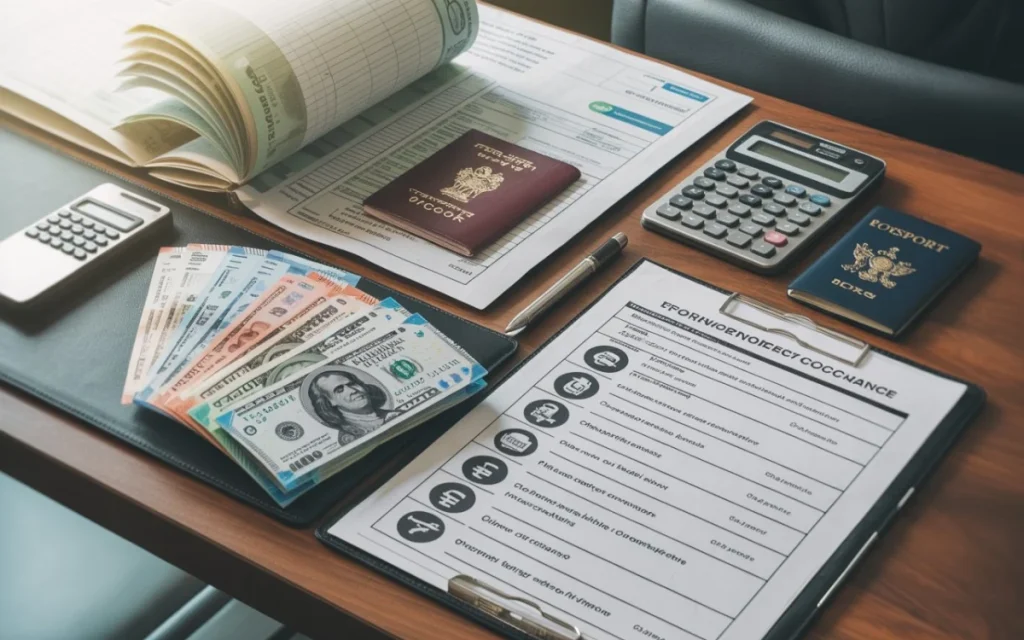
- Your original passport
- A valid visa, where your destination requires one
- Your air ticket or itinerary
- Your PAN card
- For students, the admission letter; for employment travel, the employment visa or offer letter if asked
Paying for Forex: Cash Limits and TCS
You can pay in cash only when the forex you are buying is below ₹50,000. For larger amounts the RBI requires payment by cheque, demand draft, pay order or card. Tax Collected at Source (TCS) applies once your total LRS purchases in the financial year cross ₹10 lakh: 20% on the excess for forex bought for travel, 2% from the first rupee on overseas tour packages since 1 April 2026, and 2% on the excess for education and medical remittances (IndusInd Bank). TCS can be adjusted against your income tax or claimed back when you file your return.
Tips for a Fair Deal in Trichy
- Ask for the selling rate and the final rupee amount, including charges and GST.
- Avoid last-minute airport exchange where you can.
- Ask for smaller denominations for taxis and meals.
- Check notes for tears and marks at the counter.
- Deal only with banks or RBI-authorised money changers and keep the receipt. See our guide to choosing a money changer; the checks apply in Trichy too.
Coming Back With Leftover Currency
Residents must surrender unspent foreign currency notes and travellers’ cheques within 180 days of return, but may keep up to USD 2,000 (or equivalent) for future travel. Foreign coins can be kept without limit. Bring your passport and, if you have it, the purchase receipt when you sell.
Getting Foreign Currency in Trichy With GEM Money Changers
GEM Money Changers’ Trichy branch is at Plaza Hotel No 13C, First Floor, Alam Tower, Royals Road, opposite the Central Bus Stand in Cantonment. The branch handles currency purchase and buyback, travel cards, student remittance and help with international money transfers. Call before you visit with the currency and amount; the team will confirm availability, the rate and the documents to bring.
Travelling from Trichy soon?
Call our Royals Road branch to check currency availability and today’s rate.
Frequently Asked Questions
How much foreign cash can I take from Trichy for a holiday?
For most countries, up to USD 3,000 (or equivalent) in foreign currency notes per visit. The rest can go on a travel card or international card within the LRS limit of USD 2,50,000 per financial year.
Which documents do I need to buy foreign currency in Trichy?
Usually your passport, a valid visa where applicable, your air ticket and your PAN card. Students and employment travellers may be asked for an admission or offer letter.
Can I pay cash for foreign currency?
Yes, if the purchase is below ₹50,000. For ₹50,000 and above, payment must be made by cheque, demand draft, pay order or card.
Is TCS charged when I buy forex for a trip?
Only if your total LRS purchases in the financial year exceed ₹10 lakh. Overseas tour packages attract 2% TCS from the first rupee.
What should I do with currency left over after my trip?
Sell it to an authorised money changer within 180 days, or keep up to USD 2,000 in notes for future travel. Coins can be kept without limit.
Should I exchange currency at Trichy airport or in the city?
Exchanging in the city a few days before you fly gives you time to compare rates and order less common currencies. Airport counters suit small top-ups.
Sources
- Reserve Bank of India: FAQ on miscellaneous forex facilities
- Reserve Bank of India: Master Direction on Other Remittance Facilities
- Reserve Bank of India: List of full-fledged money changers
- IndusInd Bank: TCS on foreign remittance under LRS
This article is general information, not financial, tax or legal advice. Confirm the requirements for your transaction with an authorised provider before you travel. Last reviewed: November 2026.